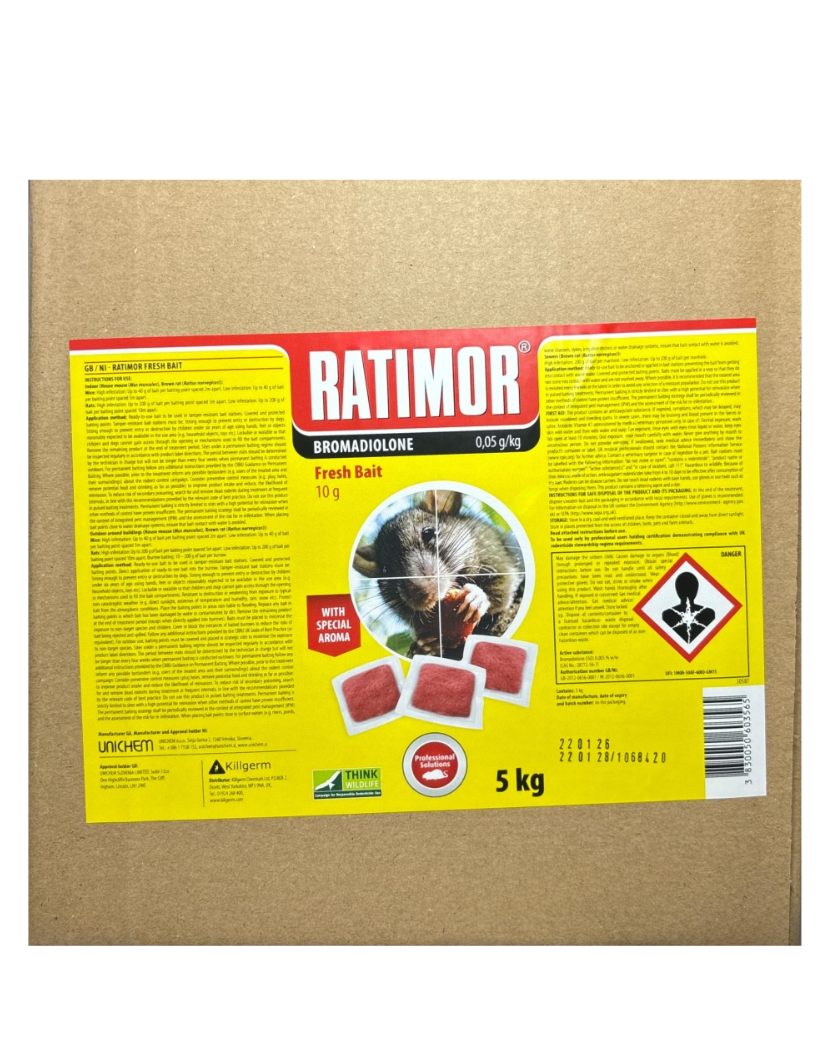
Paste bait for professional use, designed for effective control of mice and rats indoors and outdoors. Thanks to its attractive formula, the bait works well even in areas with other food sources and helps reduce rodent activity within a few days.
Bezmaksas piegāde

Rīgā bezmaksas piegāde no 70 EUR (bez PVN);
Ārpus Rīgas un Baltijā bezmaksas piegāde no 100 EUR (bez PVN).
Free shipping
Riga free shipping from 70 EUR (without VAT);
Outside of Riga and in Baltic states free shipping from 100 EUR (without VAT).
Бесплатная доставка
Бесплатная доставка в Риге от 70 евро (без НДС);
За пределами Риги и по всеи Балтике бесплатная доставка от 100 евро (без НДС).
Ratimor Paste Bait Rodenticide
Ratimor Paste Bait is a professional rodenticide designed for the effective control of house mice and brown rats. Its highly attractive paste formulation ensures excellent bait acceptance even in areas with competing food sources.
Applications
For professional use:
indoors
around buildings
open outdoor areas
waste disposal sites
sewer systems
The product should be placed in secure and tamper-resistant bait stations where rodent activity has been observed.
Action and Effectiveness
The product contains the anticoagulant active substance bromadiolone, which causes rodent mortality within 4–10 days after bait consumption.
Due to its delayed mode of action, rodents do not associate the bait with the effect, allowing effective control of the entire population.
Application Rates
House Mice
10–40 g per bait point.
Distance between bait points:
5 m
2 m in cases of heavy infestation.
Brown Rats
20–200 g per bait point.
Distance between bait points:
10 m
5 m in cases of heavy infestation.
Sewer Systems
10–200 g per manhole.
Up to 200 g per manhole in cases of heavy infestation.
Directions for Use
Use only in secure, tamper-resistant, and clearly labelled bait stations.
Do not open bait sachets that are intended to be used unopened.
Secure the bait to prevent rodents from carrying it away.
Do not place bait where it is accessible to children, pets, birds, livestock, or non-target animals.
Keep away from food, beverages, animal feed, and food-contact surfaces.
Remove any remaining bait after the treatment period.
Active Ingredient
Bromadiolone – 0.005%
Safety Information
For professional use only.
Wear chemical-resistant protective gloves (EN 374).
Do not eat, drink, or smoke while using the product.
Wash hands thoroughly after handling.
Contains an anticoagulant.
Dangerous to animals.
May damage the unborn child.
Prolonged or repeated exposure may cause damage to blood-forming organs.
First Aid
If swallowed, seek immediate medical attention.
Antidote: Vitamin K1 (to be administered only by a medical doctor or veterinarian).
Skin contact: wash thoroughly with soap and water.
Eye contact: rinse with water for at least 10 minutes.
Do not induce vomiting.
Poison Information Centre: +371 67042473
Emergency Services: 112
Hazard Statements
Danger
H360D – May damage the unborn child.
H372 – Causes damage to organs (blood) through prolonged or repeated exposure.
Storage
Store in a cool, dry, and well-ventilated place.
Protect from direct sunlight.
Keep out of reach of children, pets, birds, and livestock.
Additional Information
For trained professional users only.
Authorisation No.: LV/2013/MR/003
UFI: 1M00-50AF-600J-GM1S
Date of manufacture, expiry date, and batch number: see packaging.
Manufacturer and Authorisation Holder
UNICHEM d.o.o.
Sinja Gorica 2, 1360 Vrhnika, Slovenia
Distributor in Latvia
American Equipment & Supply
Aiviekstes 18, Riga, LV-1019, Latvia
Tel.: +371 26466885