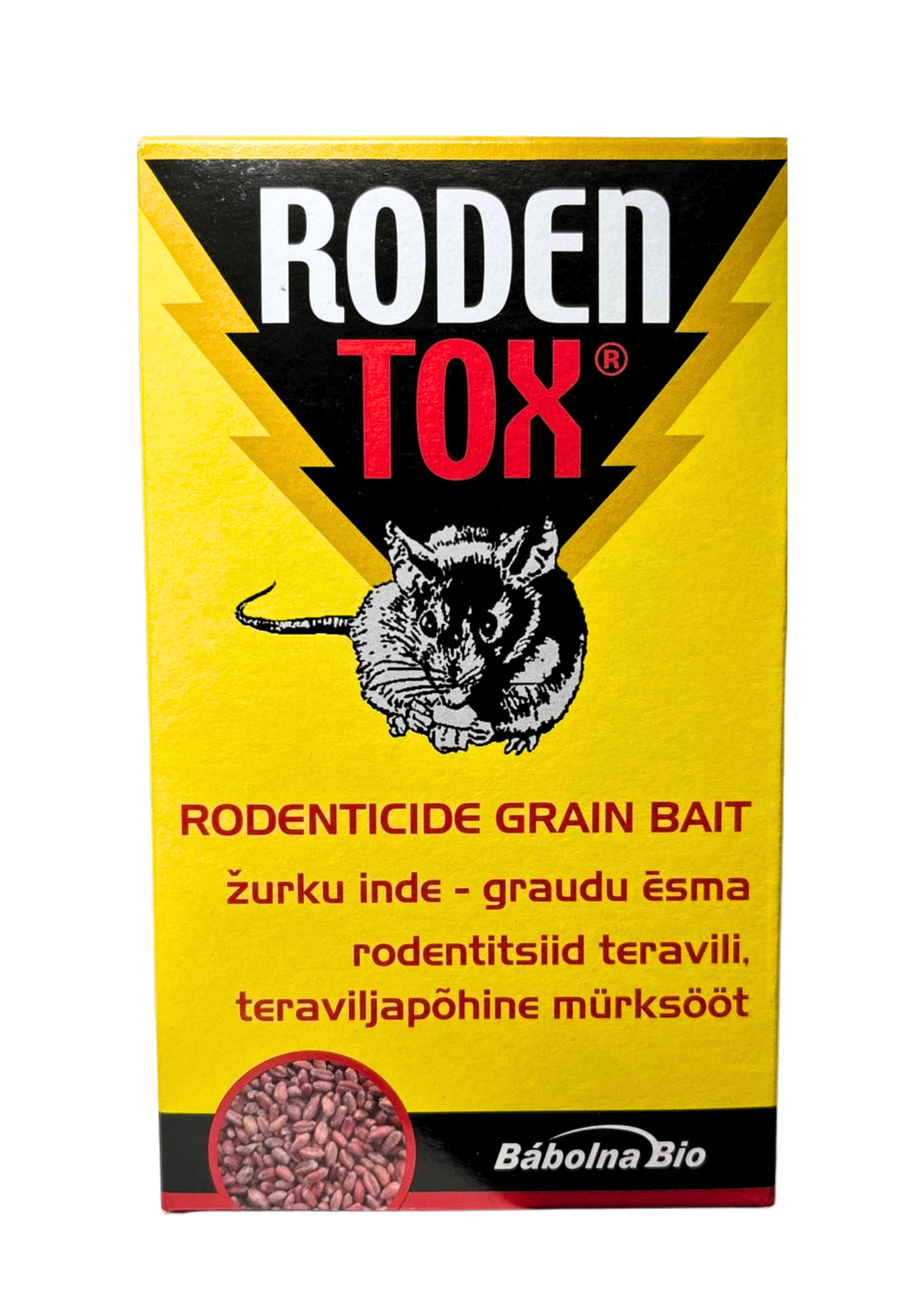
Ready-to-use grain bait for the control of Norway rats indoors and outdoors around buildings. The bait contains bromadiolone and is intended for placement in closed bait stations in areas where rat activity has been observed.
Bezmaksas piegāde

Rīgā bezmaksas piegāde no 70 EUR (bez PVN);
Ārpus Rīgas un Baltijā bezmaksas piegāde no 100 EUR (bez PVN).
Free shipping
Riga free shipping from 70 EUR (without VAT);
Outside of Riga and in Baltic states free shipping from 100 EUR (without VAT).
Бесплатная доставка
Бесплатная доставка в Риге от 70 евро (без НДС);
За пределами Риги и по всеи Балтике бесплатная доставка от 100 евро (без НДС).
| Quantity | Discounted price | Discount |
| 48 - 1000 | €1,00 | €0,20 |
RODENTOX ® is a ready-to-use rodenticide grain bait for the control of Norway rats (Rattus norvegicus) indoors and outdoors around buildings.
The product contains 0.0027% bromadiolone and is intended for non-professional use.
The product can be used for the control of Norway rats (Rattus norvegicus) indoors and outdoors around buildings.
For non-professional use.
Do not use the product for the prevention of rodent infestations or for monitoring rodent activity.
Bromadiolone – 0.0027% (0.027 g/kg).
EC No.: 249-205-9.
CAS No.: 28772-56-7.
The rodenticide contains a bittering agent (denatonium benzoate), which reduces the risk of accidental ingestion by humans.
Ready-to-use rodenticide, grain bait.
Biocidal product type / name: 14 / rodenticide.
3 odour-permeable sachets, each containing 50 g of rodenticide.
Total content: 150 g.
100–150 g (2–3 sachets) of bait per bait station.
If more than one bait station is required, the minimum distance between bait stations should be:
7 metres – for a high level of infestation;
10 metres – for a low level of infestation.
Place the product in areas where rats have been observed. The presence of rodents can be identified by typical signs such as nests, burrows, travel routes, droppings, gnawing damage and other signs of rodent activity.
Assess the level of rodent infestation based on visible signs of damage and then carry out appropriate control measures.
Before placing the product, consider whether the rodent infestation can be eliminated without using a rodenticide. Use the rodenticide only when its use is justified.
To improve the effectiveness of the treatment and prevent reinfestation, inspect the treatment area before starting the control measures.
Seal holes and burrows and, where possible, remove food accessible to rodents, such as food waste and spilled grain, as well as accessible sources of liquids.
When placing the rodenticide, avoid significantly disturbing the infested area, as this may disturb the rodent population and make bait uptake more difficult.
Place the sachets in a lockable, tamper-resistant bait station. The bait station is not included in the package.
The use of MULTIBAITER® or an equivalent bait station distributed by Bábolna Bio Ltd. is recommended.
One bait station may contain the maximum amount of bait specified in the application rate.
Where possible, secure the filter-paper sachets inside the bait station using rods or nails.
The bait station must be clearly, legibly and permanently marked to indicate that it contains rodenticide and must not be touched, moved or opened.
Keep the product packaging until the end of the treatment.
Place the bait station containing the rodenticide in areas frequented by rats, along their travel routes and near potential harbourage areas.
Ensure that the bait station is placed in a location inaccessible to children, pets, livestock and other wild animals.
Where possible, secure the bait station in place.
Protect the bait station from water, rain and adverse weather conditions.
The rodenticide may only be placed inside a closed bait station.
Check the bait points regularly: every 5–7 days at the beginning of the treatment and at least once a week thereafter.
If the sachets have been consumed, place new sachets in the bait station.
If the sachets remain untouched but rodent activity continues, move the bait station containing the rodenticide to another suitable location.
Due to the delayed action of the anticoagulant active substance, rodent mortality is expected to begin approximately 3–5 days after consumption of the bait.
Leave the bait in place only for as long as justified by rodent activity.
Rodent infestations are normally eliminated within 2–6 weeks of treatment.
If the presence of rodents and the damage caused by them do not noticeably decrease within 35 days, contact a professional pest control operator.
Use only for rodent control and in accordance with the instructions for use.
Do not use the product to kill non-target animals.
The product is toxic to mammals and birds. Dogs, cats, pigs and other predatory and/or scavenging animals may be poisoned by eating rodents that have died or been weakened as a result of consuming the rodenticide.
Do not eat, drink or smoke while using the product.
Wash hands with warm water and soap after using the product and checking the bait stations.
Do not use contaminated or damaged rodenticide.
Store and use away from food, beverages and animal feed, as well as utensils and surfaces that may come into contact with them.
Do not allow the product to enter natural waters.
Hazardous to wildlife.
H373 May cause damage to organs (blood) through prolonged or repeated exposure.
P102 Keep out of reach of children.
P202 Do not handle until all safety precautions have been read and understood.
P280 Wear protective gloves.
P308+P313 IF exposed or concerned: Get medical advice/attention.
P405 Store locked up.
P501 Dispose of contents/container in accordance with local regulations and the instructions on the label.
UFI: D7WQ-KC65-W30V-S5FK.
In the event of accidental poisoning or if poisoning is suspected, seek medical attention immediately and show the product label to the doctor.
If swallowed: seek medical attention immediately and show the product packaging, label or safety data sheet. Induce vomiting only if specifically instructed to do so by a medical professional. Rinse the mouth with water. Do not eat or drink, keep warm and seek medical attention.
Do not give anything by mouth to an unconscious person.
Following ingestion of the rodenticide, blood clotting may be reduced and internal bleeding may occur. Symptoms may appear several days after poisoning or exposure.
Delayed symptoms may include bleeding from the nose and gums. In severe cases, blood may appear in the urine or faeces.
If the product has been swallowed by an animal, contact a veterinarian immediately.
If on skin: wash the skin with plenty of water and soap. If health problems occur, seek medical advice.
If in eyes: keep the eyes open and gently rinse them with plenty of water for several minutes. Remove contact lenses, if present, and continue rinsing. If health problems occur, seek medical advice.
Store in the original, unopened packaging in a dry, cool and well-ventilated place away from light.
Shelf life: 2 years from the date of manufacture.
To prevent risks to public health and secondary poisoning, remove dead rodents during treatment at the same time as bait points are inspected.
Collect dead rodents while wearing protective gloves.
Collect the dead rodent using a plastic bag turned inside out. Then place it inside another plastic bag and tie it securely.
Place the double-bagged rodent in a closed waste container and subsequently dispose of it as household waste.
At the end of the treatment period, remove the bait points. Collect any remaining rodenticide and bait stations.
Ensure that any spilled rodenticide is cleaned up.
Rodenticide that can no longer be used for its intended purpose and has become waste must be treated as hazardous waste and taken to an appropriate hazardous waste collection facility.
LV/2013/MR/006.
Bábolna Bio Ltd.
1107 Budapest, Szállás u. 6, Hungary
Tel.: +36-1 43-20-400
AES, SIA
Ulbrokas 34A, LV-1021, Riga, Latvia
Tel.: +371 26466885