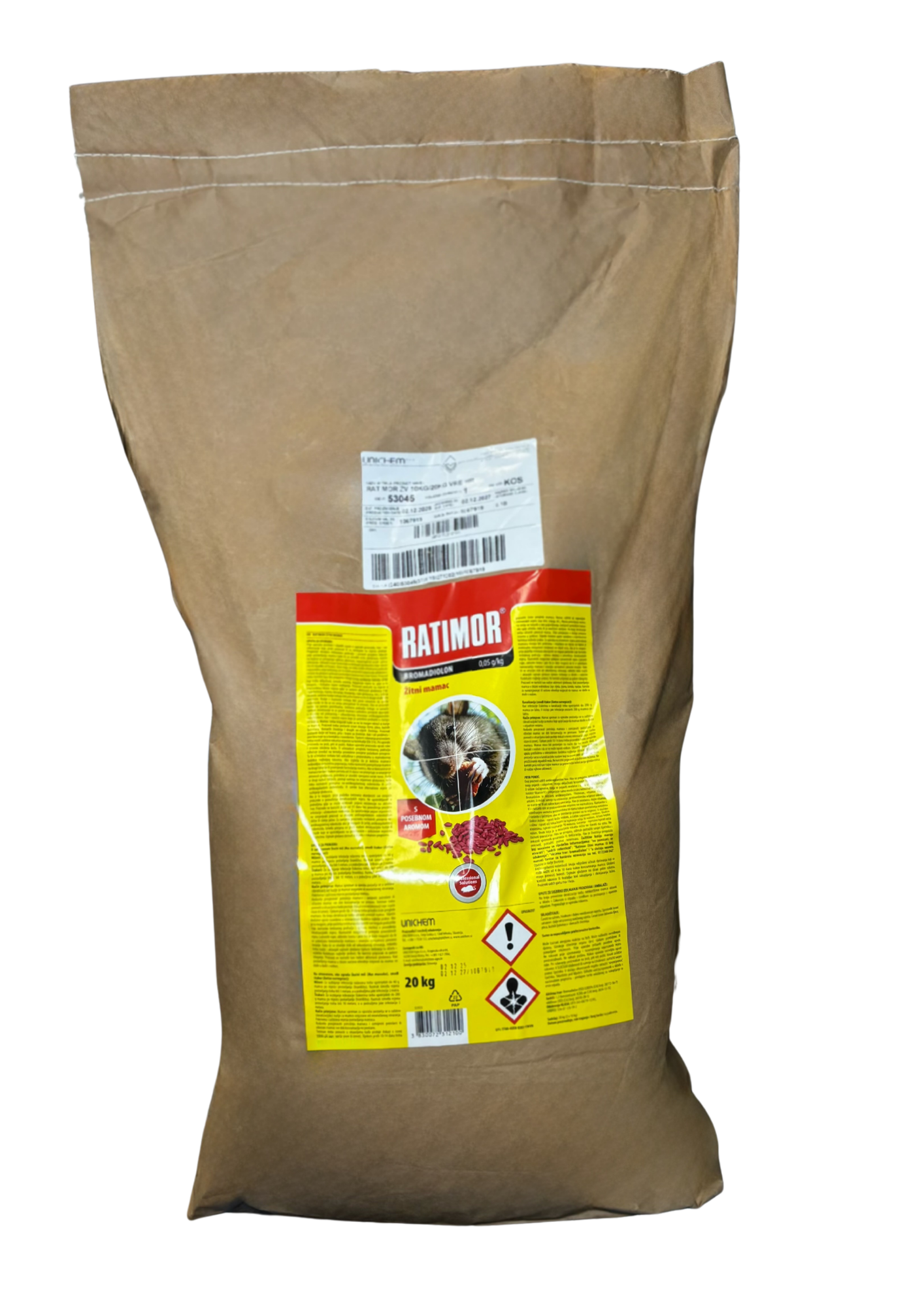
Rodenticide Ratimor bromadiolone grain bait
Guidelines and Directions for Use
Before using the product, read the product description and any other information provided with the product or at the point of sale, and follow it. To identify the rodent species, their activity area and to determine the possible causes and extent of the infestation, inspect and assess the infested area before placing the bait.
Remove easily accessible food sources for rodents (e.g., spilled grain or food leftovers). In addition, do not clean the infested area before starting control, as this will disturb the rodent population and make bait uptake more difficult.
The product should be used as part of an integrated pest management system, in addition to measures such as hygiene and, where possible, physical control methods. To encourage bait uptake and reduce the likelihood of re-infestation, consider preventive control measures (seal gaps and burrows; store food and drinks as far away as possible).
Place bait stations as close as possible to places where rodent activity has previously been observed (e.g., along runs, near nests, feeding sites, gaps, burrows, etc.). If possible, secure bait stations to the ground or other structures. Bait stations must be clearly marked to show that they contain rodenticides and must not be moved or opened.
When using the product in public areas, the treated area should be marked during the treatment, and a warning should be placed near bait stations explaining the primary and secondary risks of anticoagulant poisoning and the first actions to be taken in case of poisoning. The bait must be secured so that animals cannot drag it out of the bait station.
Place the product in areas inaccessible to children, birds, pets, farm animals and other non-target animals. Keep the product away from food, beverages and animal feed, as well as from household items and surfaces that may come into contact with them.
When using the product, wear chemical-resistant protective gloves (EN 374). Do not eat, drink or smoke during use. After use, wash your hands and any areas that were in direct contact with the product.
If bait uptake is slow relative to the size of the infested area, consider placing bait stations in additional locations and/or changing the bait type. If after a 35-day control period rodents continue to feed on the bait but rodent activity does not decrease, investigate the cause. After excluding other possible factors, the population may be resistant; consider using a non-anticoagulant rodenticide or a stronger anticoagulant rodenticide. As an additional measure, consider using traps.
When rodent control is complete, remove any remaining bait and/or bait stations. Do not open the bait sachets. Use a scoop/spatula when cleaning/disposing of bait after treatment.
If possible, inform nearby persons about the control operation before starting treatment. To reduce the risk of secondary poisoning, regularly search for and remove dead rodents during treatment (e.g., at least twice a week). Do not use the product for longer than 35 days without further assessment of the infestation status and the effectiveness of the control measures. Anticoagulant baits should not be used as permanent baiting or for monitoring.
Do not wash bait stations with water between uses. Dispose of dead rodent bodies in accordance with local requirements.
Method of Use
Ready-to-use bait intended for placement in tamper-resistant (non-openable) bait stations.
Application Rate
Indoors (House mouse (Mus musculus) or Brown rat (Rattus norvegicus))
Mice: 40 g of bait per bait station. If more than one station is required, the minimum distance between stations should be 2 m. Check bait stations at least every 2–3 days at the start of the control period and thereafter at least once a week (bait consumption, interference with stations, and collection of rodent bodies).
Rats: 200 g of bait per bait station. If more than one station is required, the minimum distance between stations should be 5 m. Check bait stations 5–7 days after the start of the control period and thereafter at least once a week (bait consumption, interference with stations, and collection of rodent bodies).
Refill bait stations as necessary. When placing bait stations near water drainage systems, ensure the bait cannot come into contact with water.
Outdoors around buildings (House mouse (Mus musculus) or Brown rat (Rattus norvegicus))
Mice: 40 g per bait station, minimum distance 2 m. Check every 2–3 days at the start and thereafter at least once a week.
Rats: 200 g per bait station, minimum distance 5 m. Check 5–7 days after the start and thereafter at least once a week.
Protect bait from precipitation (rain, snow, etc.). Place stations in areas that cannot flood. Replace the bait if it has been damaged by water or has become dirty. Do not place the product directly into burrows. When placing stations near water bodies or drainage systems, ensure the bait cannot come into contact with water.
First Aid
This product contains an anticoagulant. If swallowed, symptoms may occur (sometimes with a delay) such as nose and gum bleeding; in severe cases bruising and blood in faeces and urine. Antidote: Vitamin K1 (to be administered only by a medical/veterinary professional).
Skin contact: rinse with water, then wash with soap and water.
Eye contact: rinse with eyewash solution or water, keeping eyelids open for at least 10 minutes.
If in mouth: rinse mouth thoroughly with water.
Do not give anything by mouth to an unconscious person. Do not induce vomiting.
If swallowed, seek medical advice immediately and show the product packaging or label. If an animal has eaten the product, contact a veterinarian.
Bait stations must display the following information: “Do not move or open”; “Contains rat poison”; “product name or authorisation number”; “active substance(s)”; and “In case of accident, call the poison centre. Dangerous to animals.”
Due to delayed action, anticoagulant rodenticides act within 4–10 days after bait consumption. Rodents may carry diseases. Do not touch dead rodents with bare hands—use gloves or suitable tools (e.g., tongs). The product contains a bittering agent and a dye.
Safe Disposal of Unused Product and Packaging
After completion of the control period, dispose of uneaten bait and packaging in accordance with local requirements. The use of gloves is recommended.
Storage
Store in a dry, cool, well-ventilated place. Keep the container closed and do not store in direct sunlight. Store out of reach of children, birds, pets and farm animals.
Additional Information
For professional use only.
Content: … g
Date of manufacture, expiry date and batch number: on the packaging.
Hazard Statements
Danger
H317 May cause an allergic skin reaction.
H360D May damage the unborn child.
H372 Causes damage to organs (blood) through prolonged or repeated exposure.
P201 Obtain special instructions before use.
P202 Do not handle until all safety precautions have been read and understood.
P260 Do not breathe dust.
P264 Wash hands thoroughly after handling.
P270 Do not eat, drink or smoke when using this product.
P272 Contaminated work clothing should not be allowed out of the workplace.
P280 Wear protective gloves.
P302+P352 IF ON SKIN: Wash with plenty of water.
P308+P313 IF exposed or concerned: Get medical advice/attention.
P314 Get medical advice if you feel unwell.
P321 Specific treatment (see additional first aid instructions on this label).
P333+P313 If skin irritation or rash occurs: Get medical advice/attention.
P362+P364 Take off contaminated clothing and wash it before reuse.
P405 Store locked up.
P501 Dispose of contents/container in accordance with national regulations.
Composition
Active substance: Bromadiolone (ISO) 0.005% (CAS No.: 28772-56-7)
Contains: 1,2-benzisothiazol-3(2H)-one (CAS No.: 2634-33-5); Octylisothiazolinone (ISO) 0.0017% (CAS No.: 26530-20-1)
Authorisation No.: LV/2013/MR/005
UFI: TF00-40XN-K00J-5WVN
Manufacturer
UNICHEM d.o.o., Sinja Gorica 2, 1360 Vrhnika, Slovenia
Distributor in Latvia
SIA “American Equipment & Supply”, Riga, Aiviekstes iela 18, LV-1019, tel. +371 26466885